


|
|
|
|
 | |
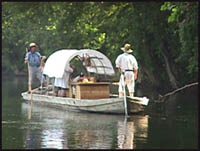
Changing transportation patterns shaped Scottsville's evolution. Beginning in 1745, the natural ford across the James River made this site attractive for the first county seat of Albemarle County. Early settlers built a ferry here to connect the village to portions of the county to the south. Bateau traffic to Richmond flourished as a means to transport produce to market and finished goods to local stores. The village's subsequent development as a transshipping point on the James River resulted in its incorporation as the Town of Scottsville in 1818. Trade and the town's importance increased when Albemarle County named flour and tobacco inspectors to serve at Scottsville, and several Shenandoah Valley counties shipped their grain to Scottsville via the Staunton and James River Turnpike. By 1835, Scottsville had a population of 600 and trade was so heavy that demand arose for building ground outside the town limits for both warehouses and residences. When the James River and Kanawha Canal opened in 1840 between Richmond and Lynchburg, the era of river navigation in Scottsville ended. Freight could be shipped on the canal more cheaply than by wagon. And the canal furnished an easy, safe, and unobstructed line of communication from east and west as it remained in operation both during floods and in times of low water. Trade in Scottsville grew, and the town's population rose to about 1000 in 1841. Although the canal remained in operation until 1881, the poorly-kept roads leading to Scottsville hampered wagon traffic that carried freight for the canal. Trade to Scottsville began to decline in the late 1840's, and by 1850, the population of Scottsville slipped to 666. Just after 1850, the Virginia Central Railroad was constructed to Charlottesville, and shippers
from the Shenandoah Valley began using the railroad vice the more difficult wagon journey overland on the
But the railroad did little to improve commerce in Scottsville as the town recovered from the Civil War. Scottsville was given no special railroad function to fill, such as a division point, and was relegated to the role of a small station of the James River Division. By 1888, there was a marked decline in freight and passengers arriving in Scottsville, but a marked increase in passengers leaving town. The census of 1890 gives Scottsville's population as only 362, a decline of 21% from 1880.
To learn more about the geology at Scottsville that helped shape the natural horseshoe bend of the James River and resulted in our town becoming a transshipping point on the James and to see transportation-related photos of Scottsville from the early 1900's, please click on each image below for a larger view and more information. |
Why The River Bends by Adam Robinson | ||
|
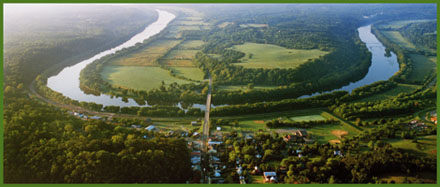
Date: ca. 1990 Photographer: Image Comments: The magnificence of the James River gives metaphors pause. To navigate its waters as fireflies gather on the cusp of a July evening, to thread a course through an autumn colonnade of poplars dipped in molten gold, is to understand why this river carries the lifeblood of Virginia within its embrace. And if you listen carefully, beneath the river's roar you might hear whispers of another time, voices of Monacan Indians and batteau captains and canal engineers, for the James River is a river flowing through time as well as space. After all, the foundations of Virginia's history are built upon this river. So, too, is the history of the town of Scottsville. Scottsville finds itself upon the Horseshoe Bend, an isolated meander of the James River, bounded for many miles to the east and west by relatively straight stretches of river. And while steep cliffs border the James River throughout much of the Piedmont, the Horseshoe Bend boasts gentle slopes on its northern and southern shores. The town's placement on this geographical oddity is no coincidence. Scottsville's early settlers, the Monacan Indians, were drawn to the area's fertile flood plains and the natural ford at the Horseshoe Bend. And when Albemarle County was established in 1744, the area that would one day become Scottsville was chosen as the location of the county's courthouse, due to its position on this convenient ford of the river. For the full article by Adam Robinson about why the James River bends at Scottsville and its impact on the town's settlement and success as a transportation center, visit Why The River Bends.Copyright � 2018 by Scottsville Museum |
||
Tutwiler's Boat Yard | ||
|
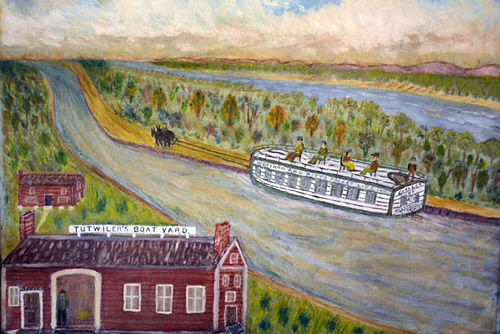
Date: 1860-1880 Image Number: CG6424cdCG2017 Comments: The painting at left by J.W. Tutwiler depicts the Tutwiler Boat Yard in Scottsville, which was owned and operated by Wesley Clark Tutwiler until his death in 1871. After his passing, Wesley's wife, Amanda Marie (Moon) Tutwiler, operated this boat yard that built and repaired canal boats for use on the James River and Kanawha Canal between Richmond and Lynchburg until the canal closed in 1880. To learn more about Tutwiler's Boat Yard, see the larger image of this painting. Copyright � 2018 by Scottsville Museum |
||
Let's Roll a Hogshead! by William E. Trout | ||
|
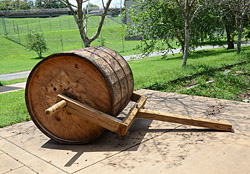
Date: 2019 Image Number: CG01cdCG2019 Comments: A picturesque phase of tobacco marketing in the Colonial and Early National period in Virginia was the practice
of rolling the hogshead of tobacco from the plantation to the place of inspection and sale. Transportation of tobacco in this manner was considered by
by William Tatham as "peculiar to the Virginia era" in a book he authored in 1800 entitled, "An Historical and Practical Essay on the Culture and Commerce of Tobacco." Copyright � 2019 by Scottsville Museum |
||
Boyd, Edmond & Davenport Packet Boats | ||
|
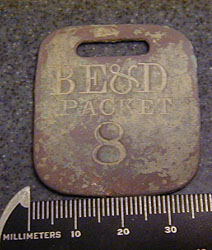
Date: ca. 1842 Image Number: JH563cdJH30 Comments: The metal tag at left reads "BE&D Packet, 8." In the mid-1800's, such small metal tags were attached to a traveler's personal luggage and usually bore the name of the issuing party (hotel, railroad or other transportation company) along with a number by which a passenger could identify his or her luggage. The BE&D initials on this baggage tag stand for the initials of Boyd, Edmond, and Davenport, the dominant packet (passenger) boat company on the James River and Kanawha Canal which was organized in March 1842. Copyright � 2018 by Scottsville Museum |
||
By Canal and By Stagecoach: A Journey from Nelson County to Staunton | ||
|
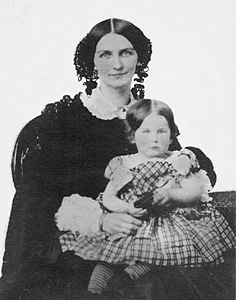
Date: ca. 1858 Image Number: Comments: Elizabeth 'Bettie' Nicholas Cabell is shown with her daughter, Annie Barraud Cabell in 1858. At age 15, Bettie
attended Virginia Female Institute in Staunton for the 1849-1850 school year. She traveled from her home at Liberty Hall in Nelson County
with her parents along the C&O canal by packet boat, "The Clinton", to Scottsville where they transferred to a stage for the rest of the trip to
her school. See the larger image for more details about Bettie's trip and the Virginia Female Institute. Copyright � 2020 by Scottsville Museum |
||
1865 Report to Stockholders of James River and Kanawha Canal by Evelyn Edson | ||
|
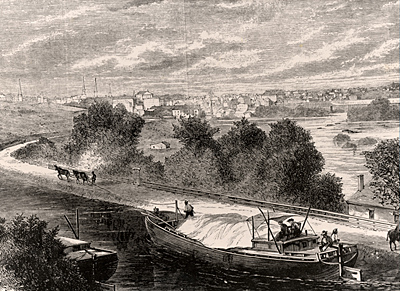
Date: 1865 Image Number: HarpersWeekly14May1870 Comments: The meeting of the James River and Kanawha Canal on October 23, 1865, was not a happy occasion. Thomas H. Ellis, President of the Board, informed his stockholders that the report of the previous year (1864) was not available. It had been at the printer when the City of Richmond was evacuated and in the general confusion was stolen or destroyed. See the larger image for more details about this stockholders' meeting. Copyright � 2020 by Scottsville Museum |
||
Train Derailment at Lock 22, 1880 | ||
|
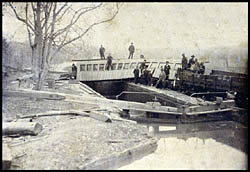
Date: 1880 Image Number: B109cdB17 Comments: In the waning days of the James River and Kanawha Canal, tracks for the Richmond & Allegheny Railroad (later C&O) were laid on the canal's towpath. This photo shows a serious train derailment that occurred at Lock 22, two miles southeast of Scottsville. See the larger image for more details about this derailment. Copyright � 2018 by Scottsville Museum |
||
Biking Through Albemarle with John Jones, 1882-1883 | ||
|
Date: 1882-1883 Image Number: LL01cdLL01 Comments: Linda Listmann of Santa Cruz, CA, is transcribing her great grandfather's journals, which began in 1875. His name was John Jones. In 1882, John was one of two astronomers, who came with Ormond Stone from the Cincinnati Observatory to oversee the building of McCormick Observatory at the University of Virginia. Stone became director of the observatory, and John helped with the building and his mentor's astronomy work. According to his journal, John arrived in Charlottesville on a bicycle and took room and board at the Emersons' home. In April 1883, John met Miss Nannie Harris of Scottsville, who came to stay with the Emersons and help out. Over the next year, a gentle romance evolved between John and his Miss Nannie. See the larger image to read more about John's biking adventures through Albemarle and frequent visits with Miss Nannie Harris and her Scottsville family during 1882-1883. All rights reserved � 2018 by Linda Listmann |
||
The Covered Bridge at Temperance Wayside | ||
|
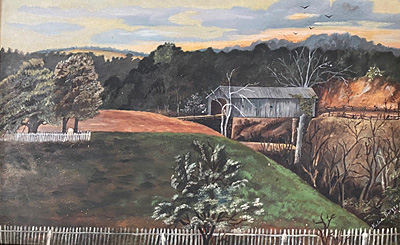
Date: Early 1900's Image Number: IED02cdIED08 Comments: "We rattle through the Hardware River's old-timey "rabbit burrow" bridge," wrote Virginia Moore, talking about life in Scottsville between the wars. This was the covered bridge built about 1850 at Temperance Wayside where Highway 6 crosses the Hardware River. Sheridan's departing troops had clattered over it in 1965. A painting by Cornelia Burgess Dorrier shows the picturesque bridge in the early 20th century, a subject to which she was to return often. In 1956 when Mrs. Dorrier was interviewed by The Scottsville Sun, the old bridge was gone, destroyed by high water and replaced with a modern bridge. To learn more about this old covered bridge, click on the photo at left. All rights reserved � 2021 by Scottsville Museum |
||
Last Crossing of Scottsville Ferry, 1907 | ||
|
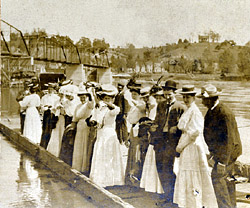
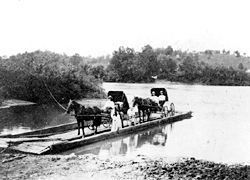
Date: 1907 Image Number: B62cdB16 Comments: Samuel R. Gault stands in the lower right corner of the Scottsville Ferry on its last crossing of the James River in 1907. The new bridge, which made the ferry obsolete, is shown behind this group of young men and women as they enjoy their last ride on this historic ferry. In 1745 Daniel Scott, son of Edward Scott, began this ferry operation at Scott's Landing, later known as Scott's Ferry and then Scottsville. Copyright � 2018 by Scottsville Museum |
||
Crossing the James via the Scottsville Bridge, 1907 | ||
|
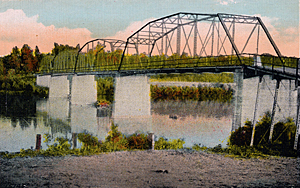
Date: 1907 Image Number: B53bcdB16 Comments: The first bridge over the James River at Scottsville was built in 1907 from Scottsville to Buckingham across the river. The new bridge, which made the ferry obsolete, was made with steel girders and wooden planks on the bridge floor. This bridge stayed in operation from 1907 until it was replaced in 1968 by a concrete bridge built upstream from the first bridge. To learn more about this bridge and its 1968 replacement, click on the photo at left. Copyright � 2020 by Scottsville Museum |
||
Dr. Stinson Attends to His Practice | ||
|
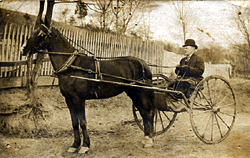
Image Number: B13cdB13 Comments: The trusty horse and buggy served Scottsville well as its primary means of transportation before 1910. In this photo, Dr. Luther R. Stinson rides out of Scottsville to tend to a patient. Born across the James River in Buckingham County, Virginia, Dr. Stinson graduated from the University of Virginia Medical School and set up his Scottsville practice.
Copyright � 2018 by Scottsville Museum |
||
The Hatton Ferry, ca. 1910 | ||
|
Image Number: B69cdB16 Comments: Located on the James River near Scottsville, the Hatton Ferry began operation in the late 1870's and is shown here as seen from the Buckingham County shore in 1910. Hatton Ferry continues operation today and is one of the last two poled ferries remaining in the United States. See the larger image as a guide to the passengers' names.
Copyright � 2018 by Scottsville Museum |
||
The Scottsville Bridge | ||
|
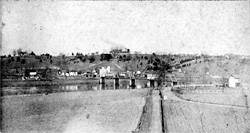
Image Number: RollOneNeg23A Comments: The wooden bridge over the James River to Scottsville was erected in 1907 and is shown here from the Buckingham County side of the river. The bridge replaced the 162-year old Scottsville Ferry, and soon horses and buggies and automobiles clattered together across its wooden planks. See the larger image as a guide to points of Scottsville interest.
Copyright � 2018 by Scottsville Museum |
||
"Auto Endurance Test" on Valley Street, 1914 | ||
|
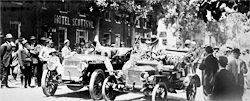
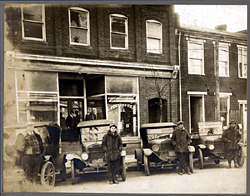
Date: 1914 Image Number: RollTwoNeg20A Comments: The first car in Scottsville was this 1910 bright-red Maxwell, owned by Dr. L. R. Stinson. Copyright � 2018 by Scottsville Museum |
||
Train Watching at Scottsville Depot | ||
|
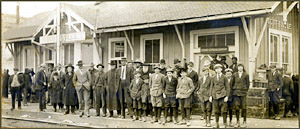
Image Number: Roll4Neg9A Comments: The James River Division of the Chesapeake and Ohio, built in 1881, was of great importance to Scottsville as it hauled freight, passengers, and the daily mail to town. A purely Scottsville amusement in the early 1900's was watching the train go by. As shown here, it was common to see a good-sized group of townsfolk strolling down to the depot with Postmaster Gault to meet the Number 11 from Richmond and pick up the day's mail. See the larger image as a guide to the names of these town citizens waiting on the platform at Scottsville Depot. Copyright � 2018 by Scottsville Museum |
||
Getting Off the 'Cars' from Richmond | ||
|
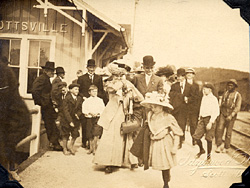
Date: ca. 1914 Image Number: H174cdE3 Comments: Riding the 'cars' in 1914 was still a popular mode of travel, as shown in this photo at Scottsville Depot. Burgess captured the William Day Smith family arriving on the Richmond passenger train. Note the throng of townspeople gathered at the depot to watch the train arrive, a Scottsville custom that may date back to the late 1800's when seeing 'cars' drawn by a steam engine was a sight to behold. Copyright � 2018 by Scottsville Museum |
||
Rural Mail Carriers in Scottsville, 1915 | ||
|
Image Number: B15cdB13 Comments: Four rural mail carriers pose in front of the Scottsville Post Office on a crisp fall day. See the larger image as a guide to these men's names.
Copyright � 2018 by Scottsville Museum |
||
Passenger Train from Richmond | ||
|
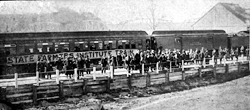
Date: ca. 1915-1916 Image Number: RollTwoNeg19A Comments: The passenger train from Richmond made four trips daily to Scottsville in 1915. The last passenger train stopped in Scottsville in 1956, and the C&O depot was closed in August 1977. Copyright � 2018 by Scottsville Museum |
||
Paving Route 20 to Charlottesville, 1921 | ||
|
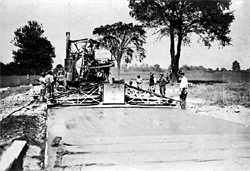
Image Number: Roll4Neg3A Comments: The road (Route 20) between Scottsville and Charlottesville was known as the Road of the Presidents in the 1800s because Presidents Jefferson, Madison, and Monroe often traveled over it. In those years, the trip between the two towns was arduous and bone-jarring as the macadam used on the road was a thin, poor tar mixture that soon broke up under heavy wagon traffic. Then rains would further plague travelers as they slid around on the rutted, muddy road. This photo shows the paving of Route 20 with concrete by the Maloney Paving Company in 1921, the first road in the county to be paved with the use of state funds. See the larger image for the historic significance this event had on Scottsville commerce. Copyright � 2018 by Scottsville Museum |
||
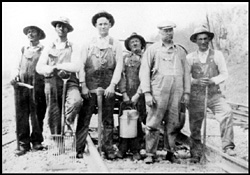
The Nicholas Section Crew, 1931 | ||
|
Image Number: FS01cdFS01 Comments: The Nicholas Section crew maintained the six-mile section of Chesapeake & Ohio Railroad track just east of Scottsville. During the Depression, each crewmember worked 40-hour weeks and earned $3.26 a day. Their work was physically demanding, and danger was a constant companion. See the larger image for more information and the names of Nicholas Section crewmembers. Copyright � 2018 by Scottsville Museum |
||
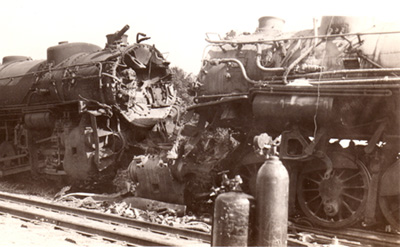
Train Wreck! | ||
|
Image Number: Comments: It was early in the morning of September 10, 1935, when two C&O freight trains collided head on just east of Warren. There was a single track there, and the west-bound train received a signal to move onto a siding to let the east-bound train through. The engine had received the signal at Strathmore, just west of Bremo, but apparently fell asleep until he was rudely awakened at 1:05 a.m. In his defense, he said he had been on duty for almost eleven hours and twenty minutes. To learn more about this 1935 train wreck, click on the photo at left. All rights reserved � 2022 by Scottsville Museum |
||
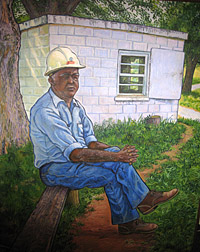
Ned Hocker, Hatton Ferry Poleman | ||
|
Image Number: CG0107 Comments: In this 1973 painting, Ned Hocker sits in front of his cinderblock ferry master's hut at Hatton Ferry. Ned began his ferry poleman career at Hatton at 17 years of age and had just notched his 43rd year on the job in 1973. Ned's muscles supplied all the power for the ferry's movement across 600 feet of James River from this Albemarle County riverbank to the Buckingham County shore. He greatly enjoyed his passengers, his job, and the James River. To learn more and see more images of this crash, click on the photo at left. Copyright � 2018 by Scottsville Museum |
||
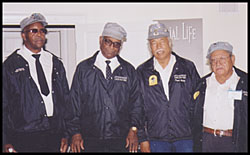
'Gang' Makes Railroad History Come Alive, June 04, 2003: | ||
|
Image Number: Not available Comments: Four members of the Buckingham Lining Bar Gang visited Scottsville Museum for oral history discussions. Shown in this photo are: (L to R) John Laury, Charles White, Francis Austin, and William Neighbors. These four gentlemen are part of a group of 10 re-enactors, who live and breathe the traditions of old time Virginia railroad workers. Through their railroading demonstrations, singing, and storytelling, the Gang offers a unique perspective on American life. See the larger image for more information and the names of the Gang members. Copyright � 2018 by Scottsville Museum |
||
 | ||||
|
Museum
Archive
Business
Cemeteries
Church
Events
Floods
For Kids
Homes
Portraits
Postcards
School
Transportation
Civil War WWII Esmont Search Policy |
||||
| Scottsville Museum · 290 Main Street · Scottsville, Virginia 24590 · 434-286-2247 | ||||
|
www.avenue.org/smuseum · info@scottsvillemuseum.com Copyright © 2018 by Scottsville Museum |
||||
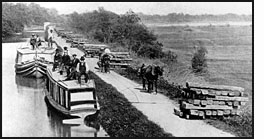 Staunton and James River Turnpike to Scottsville. They preferred instead the shorter and
better turnpike to Charlottesville and its railroad transportation east. Besides meeting much
competition from the railroads, the canal also suffered major damage during the Civil War and from
two major floods in the 1870's. As it teetered on the brink of financial failure, the James River
and Kanawha Company deeded the canal to the Richmond and Allegheny Railroad in 1880, which began
building their track on the old canal towpath. The railroad section
through Scottsville was completed the following year along with the first telegraph line.
Thus Scottsville was connected with the outside world by modern facilities of transportation and
communications.
Staunton and James River Turnpike to Scottsville. They preferred instead the shorter and
better turnpike to Charlottesville and its railroad transportation east. Besides meeting much
competition from the railroads, the canal also suffered major damage during the Civil War and from
two major floods in the 1870's. As it teetered on the brink of financial failure, the James River
and Kanawha Company deeded the canal to the Richmond and Allegheny Railroad in 1880, which began
building their track on the old canal towpath. The railroad section
through Scottsville was completed the following year along with the first telegraph line.
Thus Scottsville was connected with the outside world by modern facilities of transportation and
communications.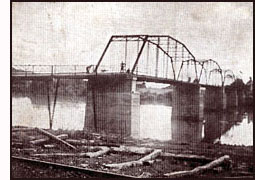 Highway transportation received a boost in 1907 with the construction of the Scottsville Bridge
over the James River. Continued highway improvements and the affordability of automobiles facilitated
trade and also made Scottsville's population highly mobile. Following countrywide trends as rural
America moved to the city, Scottsville's population fell to 283 in 1910.
By the end of World War I, however, two State highways intersected in Scottsville, and Scottsville once again
served as a market, shipping, and distributing center. The town's population in 1920 exceeded
330, and Scottsville had twenty stores, two large flour mills, an ice plant, a theater, three garages, a braid factory, two large oil companies, two hotels, two lumber plants, two restaurants,
one boarding house, two drugstores, three doctors, one dentist, two schools, two dairies,
one hospital, one shoe shop, and two blacksmith shops.
Highway transportation received a boost in 1907 with the construction of the Scottsville Bridge
over the James River. Continued highway improvements and the affordability of automobiles facilitated
trade and also made Scottsville's population highly mobile. Following countrywide trends as rural
America moved to the city, Scottsville's population fell to 283 in 1910.
By the end of World War I, however, two State highways intersected in Scottsville, and Scottsville once again
served as a market, shipping, and distributing center. The town's population in 1920 exceeded
330, and Scottsville had twenty stores, two large flour mills, an ice plant, a theater, three garages, a braid factory, two large oil companies, two hotels, two lumber plants, two restaurants,
one boarding house, two drugstores, three doctors, one dentist, two schools, two dairies,
one hospital, one shoe shop, and two blacksmith shops.